The photovoltaic industry has reached a turning point: It is now a major source of energy, and the dominant one in certain regions of the world. Further improving its environmental impact remains a key driver of industrial competitiveness, essential for ensuring the sector's growth and addressing societal challenges. It is also an important factor in helping the industry stand out from competitors outside Europe.
The RESILEX project aims to improve the resilience and sustainability of the entire silicon value chain by developing solutions to reuse silicon in the photovoltaic industry and by designing new products and strategies to reduce the sector's environmental impact.
In this context, the CEA has partnered with CSEM, the renowned Swiss research and development center, to conduct an eco-design study focusing on the interconnection stage of solar cells and the selection of materials used to assemble photovoltaic panels—referred to as the BOM, or “bill of materials"—to achieve better environmental performance while maintaining overall technical and economic performance.
The goal here is to develop heterojunction photovoltaic panels with exemplary power output and reliability while ensuring a reduced environmental impact and a European supply of components.
For the panel manufacturing stage and the selection of assembly materials, the goal was to identify a reliable alternative to glass, one of the largest contributors to the carbon footprint of solar panels. The study led to the use of bio-based polymers combined with innovative, bio-based encapsulation materials (non-cross-linking thermoplastics), while demonstrating long-term reliability without compromising electrical performance.
As part of a “Design for Recycling" approach, our researchers opted for fluoropolymer-free front and back sheets sourced in Europe. Adhesion tests led to the selection of a bio-based polymer for the front sheet, which proved to be compatible with the project's encapsulants. The modular design allows for the use of the bio-based polymer on both the front and back surfaces, enabling the project's cells and encapsulants to be integrated into several configurations.
The development strategy and the various prototype production campaigns, established and carried out jointly with CSEM, have generated a range of concrete results—many of which are highly instructive and, in some cases, promising.
Of particular note is a bio-based BOM that has been experimentally validated and assembled in France, which achieves a 70% reduction (excluding cells) in the carbon footprint compared to a reference model with glass on the front and back—manufactured in Asia, like most panels installed in Europe. This performance was achieved by replacing the glass in heterojunction solar panels with a bio-based polymer on both the front and back, combined with a partially bio-based encapsulant—both materials manufactured in France.
The experiment demonstrated the potential of these polymers for lightweight module applications with heterojunction cells. The aging tests are very encouraging: the module exceeded the standard by a factor of 2—that is, 2,000 hours of humid heat exposure—with less than 5% loss, while the reference module exceeded the IEC standard by a factor of 3, or 3,000 hours.
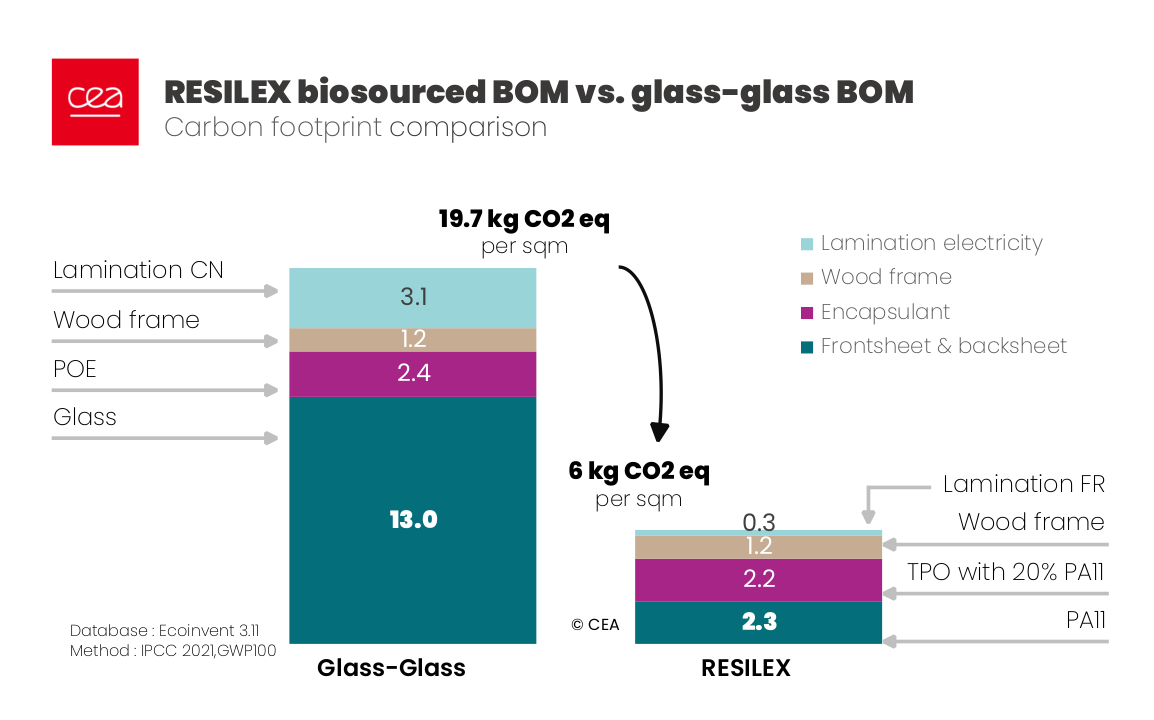
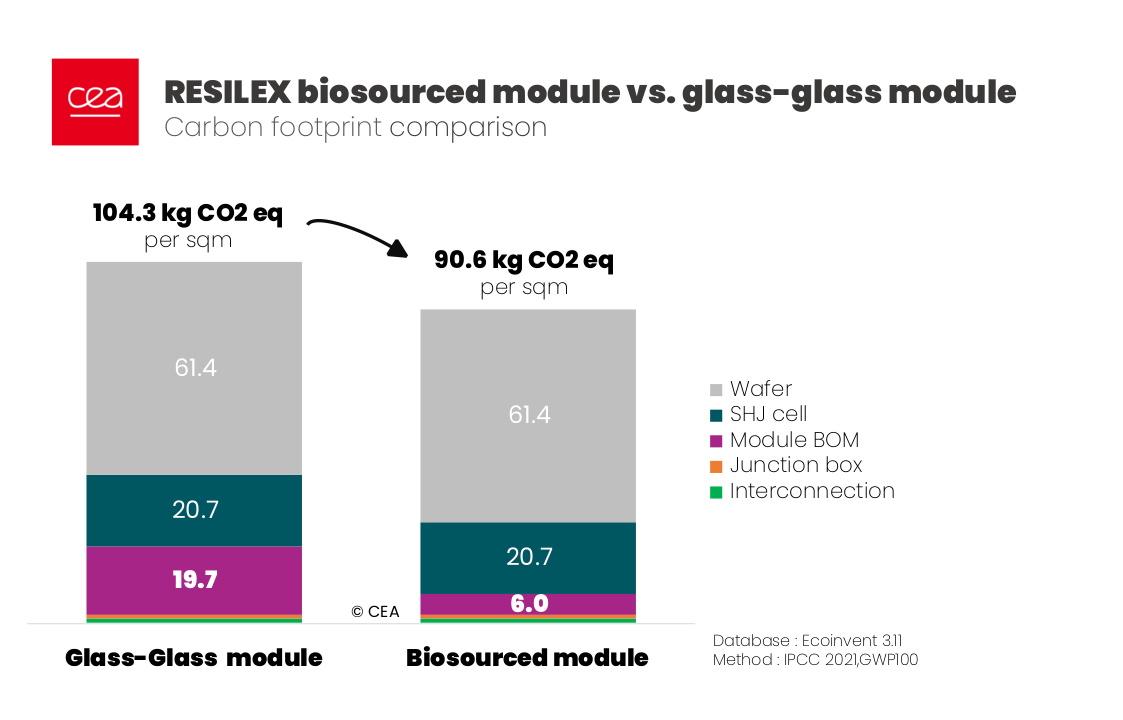
This represents a 13% reduction in the photovoltaic panel's overall carbon footprint, when adding the footprint of the silicon wafers and cells, which are the largest contributors.
Publications :
- SiliconPV 2025: Design – for - recycling of SHJ modules with drastic reduction of Ag and In contents, 15th SiliconPV, 8-11/4/2025, Oxford, UK
- Coming in 2026: Lightweight SHJ modules with reduced environmental impact: an iterative approach of BOM development and validation, EUPVSEC 14-18/09/2026, Rotterdam, Pays-Bas
The RESILEX Project (Horizon Europe): Improving the resilience and sustainability of the entire photovoltaic silicon value chain.
In particular, it aims to develop solutions for reusing silicon, recycling photovoltaic modules, and designing new products and approaches to reduce the environmental impact of solar panel production.
Regarding cell manufacturing and their integration into photovoltaic panels, the project's objectives are ambitious:
- 50% reduction in the carbon footprint
- Demonstration of cell manufacturing with at least a 70% reduction in indium and silver, and exploration of solutions to eliminate them entirely
- Reducing costs by 25% while maintaining a cell efficiency of >25% with exemplary power output and reliability
- Glass-free heterojunction panels, 100% polymer
- Reliability of bio-based and/or recyclable materials
- Implementing a comprehensive material assembly that facilitates recycling and reduces the carbon footprint.
The project, coordinated by ISMC, is led by a consortium of 21 partners from 8 European countries (including Switzerland and the United Kingdom). It began in 2022 and will conclude in June 2026.
https://www.resilex-project.eu/


Funded by the European Union (Grant n°.101058583) Views and opinions expressed are however those of the author(s) only and do not necessarily reflect those of the European Union or HADEA. Neither the European Union nor the granting authority can be held responsible for them.
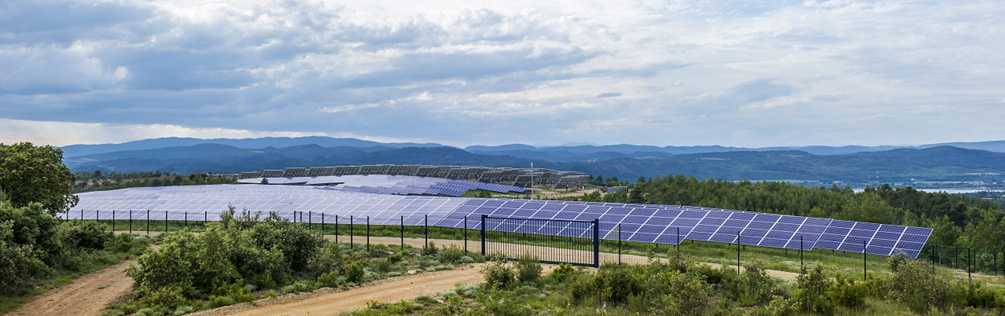
MEGASOL photovoltaic power plant – Cadarache – Credit: L. GODART / CEA
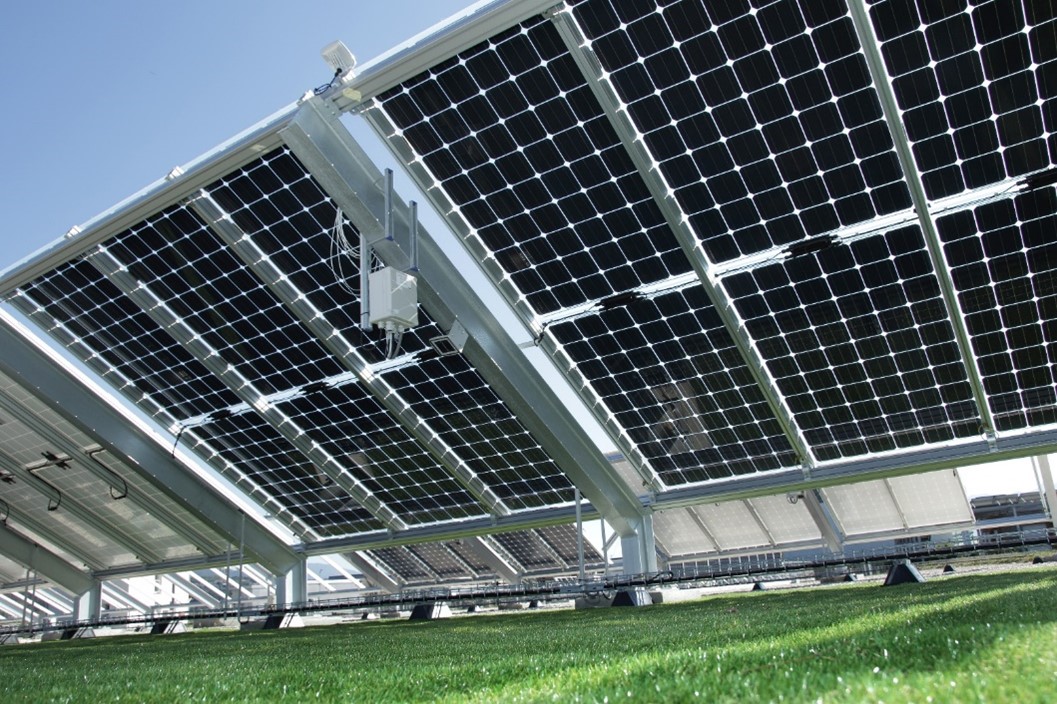
Example of glass-to-glass photovoltaic panels - Outdoor platform on the INES site.
Crédit : P. AVAVIAN / CEA